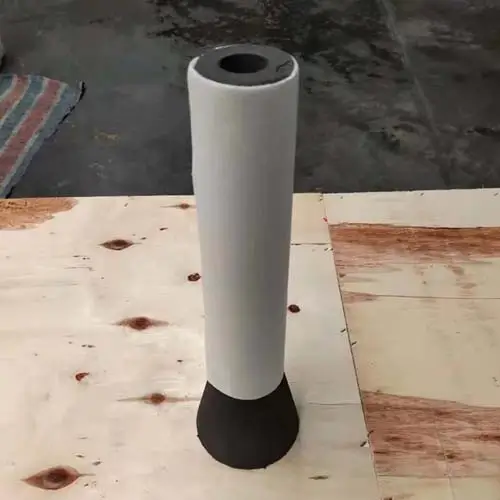
In continuous casting technology, a submerged entry nozzle (SEN) is installed between the tundish and the mold to improve the quality of the cast strand. Its primary functions are: (1) preventing secondary oxidation and nitridation of the molten steel, as well as splashing; (2) regulating the flow pattern and injection speed of the molten steel; (3) preventing mold flux and non-metallic inclusions from being entrapped in the molten steel, while facilitating the flotation of inclusions; and (4) exerting a decisive influence on the casting yield and the quality of the cast strand.
The SEN is mounted at the bottom of the tundish and extends into the mold. Its main configurations include:
A Monoblock SEN: This type does not require a separate tundish nozzle; it features an elongated shape, typically exceeding 700 mm in length. There are two variations: the internal-mount type, installed from inside the tundish outward as a single-piece unit with excellent sealing properties; and the external-mount type, installed from the tundish bottom inward (a method not yet in use domestically).
B Externally-mounted SEN: This type operates in conjunction with the tundish upper nozzle. During operation, the upper end of the SEN is suspended from the tundish bottom via a support ring or robotic arm, connecting to the upper nozzle, while the lower end extends into the mold.
C Quick-change SEN: Functionally similar to the lower nozzle of a slide gate system, this type is primarily used for slab and wide/thick slab continuous casting. It operates in conjunction with a quick-change tundish upper nozzle and represents the future trend in development.
D Thin-slab SEN: Specifically developed for thin-slab continuous casting requirements, this type is characterized by flat discharge ports and a thickness ranging from 60 to 80 mm.
SENs possess a certain degree of porosity and gas permeability; consequently, external air can penetrate the nozzle body due to the negative pressure generated by the flowing molten steel, leading to oxidation upon contact. Therefore, an anti-oxidation glaze coating must be applied to the outer surface of both long nozzles and SENs. Regardless of material or structural design, all SENs must meet the following requirements:
(1) Ensure adequate molten steel throughput at normal casting speeds;
(2) Promote uniform heat flux distribution across the cast strand’s cross-section within the mold;
(3) Facilitate the rapid melting of mold flux;
(4) Promote the flotation of inclusions and prevent slag entrapment;
(5) Avoid violent turbulence of the molten steel surface within the mold;
(6) Ensure ease of installation.
In the early stages of continuous casting, fused silica submerged entry nozzles (SENs)—characterized by high purity and good thermal stability—were used to cast grades such as ordinary carbon steel, low-manganese steel, and aluminum-killed steel. However, they suffer from severe erosion when used with high-manganese steels or high-basicity slags. Consequently, alumina-graphite SENs became widely adopted. Manufactured from materials such as premium-grade bauxite and fused or sintered corundum, with the addition of graphite and antioxidants, these nozzles offer advantages such as erosion resistance and thermal shock resistance.
To address the issue of severe erosion at the slag line and prevent nozzle clogging caused by alumina adhesion, a series of new SENs have been developed based on the alumina-graphite composition.
A Al2O3-C/ZrO2-C Composite Nozzle
With the continuous development of continuous casting technology, the diversification of steel grades, and increased casting speeds, there is a demand for enhanced corrosion resistance at the slag line; consequently, a ZrO2-C composite layer is employed in this region. Due to its excellent chemical stability, ZrO2 resists corrosion by CaO-Al2O3-SiO2 based mold fluxes. At high temperatures, ZrO2 dissolving into the flux increases the flux’s viscosity, while undissolved ZrO2 particles increase its apparent viscosity; this reduces the flux’s corrosive effect on the ZrO2-C layer and improves the nozzle’s durability. Higher ZrO2 content correlates with stronger corrosion resistance.
B (MgO-C)-(Al2O3-C)-(ZrO2-C) Composite Nozzle
To enhance the durability of the submerged entry nozzle, MgO-C material is used at the steel discharge ports to extend service life and improve casting speed control, while ZrO2 or BN is used at the slag line to boost corrosion resistance. Al2O3-C material is used for the nozzle body.
C ZrB2-C Protective Sleeve
The protective sleeve for the slag line section of the submerged entry nozzle requires a material with good spalling resistance. Since ZrC and ZrN exhibit poor high-temperature stability, zirconium borides are selected. A ZrB2-C material is used, with the addition of an appropriate amount of metallic Al to enhance corrosion resistance; the critical particle size of ZrB2 is reduced to prevent any decline in spalling resistance.
D Submerged Entry Nozzle with AZT and AZTS Additions
Al2O3-ZrO2-TiO2 (AZT) and Al2O3-ZrO2-TiO2-SiO2 (AZTS) materials—synthesized via sintering and electro-fusion—feature low thermal expansion coefficients, corrosion resistance, and stability in reducing atmospheres. By utilizing AZT and AZTS raw materials combined with a specific ratio of fused silica (FS) and a resin binder, submerged entry nozzles are produced via isostatic pressing. These nozzles exhibit excellent performance characteristics, including high mechanical strength, corrosion resistance, and good thermal shock resistance, thereby meeting the requirements for multi-heat continuous casting. The addition of AZT and AZTS imparts excellent thermal shock resistance to the nozzles; among them, the submerged entry nozzle (SEN) containing AZTS exhibits the best thermal shock resistance.
E Submerged Entry Nozzles for Extended Multi-Heat Continuous Casting
After overcoming challenges such as internal bore clogging and issues with anti-oxidation coatings, a heat-insulating, argon-purging SEN was developed. By minimizing temperature gradients, this design prevents stress-induced cracking and reduces slag accumulation within the bore to varying degrees, enabling extended multi-heat continuous casting on Baosteel’s large-scale slab continuous casting machines.
F Thin-Walled Alumina-Carbon/Zirconia-Carbon Submerged Entry Nozzles
These thin-walled SENs feature a composite structure comprising an upper alumina-carbon section and a lower zirconia-carbon section, resulting in a wall thickness of only 12.5 mm. They offer superior thermal shock and erosion resistance; in service, they exhibit no spalling or cracking and minimal erosion. These properties help increase the number of consecutive heats, reduce refractory consumption, and improve cast slab quality.