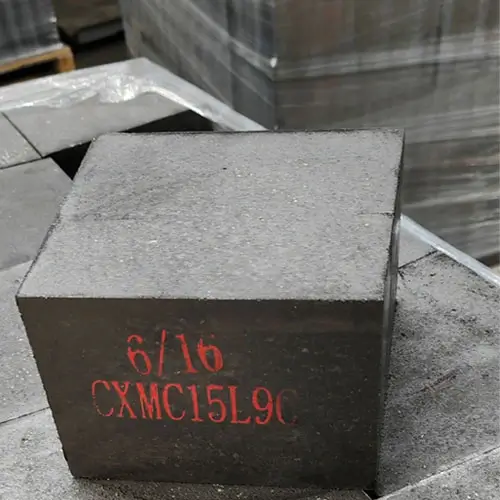
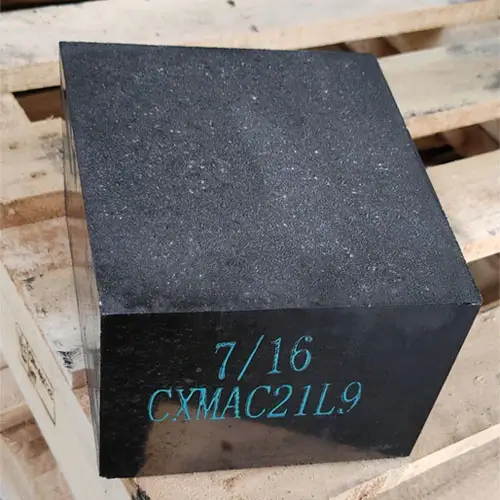
Magnesia-carbon bricks are non-burning composite refractory materials made from high-melting-point basic oxide magnesium oxide (melting point 2800℃) and high-melting-point carbon materials that are difficult to wet by slag, with the addition of various non-oxide additives. They are bonded together using carbonaceous binders. Magnesia-carbon bricks are mainly used as linings in converters, AC electric arc furnaces, and DC electric arc furnaces, as well as in slag lines of steel ladles.
The main process factors affecting the performance of magnesia-carbon bricks include raw materials, binders, and additives.
1.Magnesia
Initially, high-purity sintered magnesia was used in the production of magnesia-carbon bricks abroad. However, further research into the use of magnesia-carbon bricks revealed the following reaction at high temperatures:
MgO+C→Mg↑+CO↑
This reaction typically begins at 1650℃ and intensifies at 1750℃, which is one of the important reasons for the loss of magnesia-carbon bricks during use, and also why the loss of magnesia-carbon bricks increases significantly above 1700℃. Impurities in magnesia, such as SiO2 and Fe2O3, promote the above reaction; therefore, high purity magnesia is desirable.
Compared to sintered magnesia, fused magnesia has a more complete crystalline structure and a more stable carbon reduction effect, especially with large-crystal fused magnesia, which exhibits these characteristics more prominently. Therefore, the production of magnesia-carbon bricks has begun to shift towards the use of fused magnesia. Considering the carbon bonding state and the wettability of the binder, fused magnesia and sintered magnesia can also be used in combination. Magnesia-carbon bricks in my country are basically made using fused magnesia.
Results from the use of magnesia-carbon bricks show that using magnesia with high MgO content, large periclase phase crystal particles, and a calcium-silicon ratio greater than 2 yields the best results in the production of magnesia-carbon bricks.
2.Graphite
Graphite is another fundamental component of magnesia-carbon bricks. Graphite possesses excellent basic refractory properties, with key physicochemical indicators including: fixed carbon 85%–98%, ash content 13%–2% (mainly SiO2, Al2O3, etc.), relative density 2.09–2.23, and melting point 3640K (volatile). Because graphite is highly susceptible to oxidation, it has long been overlooked.
During the use of magnesia-carbon bricks, graphite oxidation occurs for three main reasons:
(1) Oxidation of graphite by oxygen in the air;
(2) Oxidation of graphite by oxides in the slag;
(3) Oxidation of graphite by impurity oxides contained in the graphite itself. These oxides mainly refer to SiO2 and Fe2O3.
After the impurity oxides in magnesia-carbon bricks react with graphite, the brick structure becomes loose, its permeability increases, and its strength decreases. This is the internal cause of magnesia-carbon brick damage. Therefore, high-purity graphite with large phosphorus flake crystals is mostly selected for the production of magnesia-carbon bricks.
3.Binder
The binder plays a crucial role in magnesia-carbon bricks and other carbon-containing refractory products. Graphite and refractory oxides are miscible and cannot sinter together; at room temperature, they rely on the binder for bonding and curing. At high temperatures, the binder cokes and carbonizes, forming a carbon bond with the graphite. Generally, this binder refers to organic materials such as resins and asphalt. After high-temperature coking, the binder forms approximately 3% carbon. Although this amount is small, it is the most reactive component in magnesia-carbon bricks and other carbon-containing products, significantly impacting their high-temperature performance. One important reason for the instability in the production process and product quality of magnesia-carbon bricks and other carbon-containing products in my country is the instability of the binder.
Magnesia-carbon brick binders can be broadly classified into three types: phenolic resins, modified asphalt, and petroleum cracking byproducts. Among these, phenolic resins are the most effective and widely used.
4.Additives
In the process of magnesia-carbon brick failure, graphite oxidation is one of the primary causes. Oxidation leads to carbon loss, resulting in a porous brick structure and reduced strength. The failure process follows a path of oxidation-carbon loss → porous structure → erosion → scouring and dissolution. To improve the oxidation resistance of magnesia-carbon bricks, certain additives can be added, including silica fume, aluminum fume, FeSi alloy, CaSi alloy, SiC, Si3N4, and B4C. Another function of these additives is to “bridge” the refractory oxides and graphite, enabling a strong bond between them. This effect is facilitated by the formation of new mineral phases at certain temperatures.
In my country, the most commonly used additives in the production of magnesia-carbon bricks and other phosphorus-containing refractory products are aluminum fume, silica fume, and SiC powder.
More details about magnesia-carbon bricks
What are magnesia carbon bricks?
MgO-C bricks are composed of magnesia clinker, flake graphite, antioxidants, resin components, etc., and have high resistance to corrosion, spalling, and slag penetration thanks to the characteristics of their constituents.
What is the function of magnesia in brick?
Magnesia Brick is mainly used in basic open-hearth furnace for steelmaking, electric furnace, rotary cement kiln, heating furnace, glass furnace and hyperthermia tunnel kiln with properties of higher refractoriness, good basic slag erosion resistance and high apparent initial softening temperature.
What is the melting point of magnesia carbon bricks?
2800℃.
Magnesia carbon brick is a non-burning carbon composite refractory with high melting point basic oxide magnesium oxide (melting point 2800℃) and high melting point carbon material which is difficult to be penetrated by slag as raw materials, adding various non-oxide additives and combining with carbon binder.
What is the purpose of magnesia in brick?
Magnesia brick is used for permanent layers in steel making converters, AOD furnaces, and more. Magnesia brick is also used to line steel ladles and Basic Oxygen Furnaces (BOFs). Additionally, magnesia bricks are used in steelmaking furnaces, electric furnace bottom and wall, and high temperature tunnel kiln.