EBT tapping hole
EBT (Eccentric Bottom Tapping) technology, also known as eccentric bottom tapping, was successfully developed in 1978 by the German companies Mannesmann-Demag and Thyssen. EBT technology involves adding a tapping hole to the furnace bottom at the rear of the furnace, 20–60 cm from the furnace wall. The tapping hole consists of two layers: the base brick and the tapping channel brick (also known as the tapping brick or sleeve brick). The tapping bricks are installed within the base bricks, which are fixed in place at the tapping port and connected to the surrounding furnace bottom by rammed refractory material and furnace bottom refractories. The upper layer is called the EBT top brick, and the lowest layer is called the tail brick. A filling hole is located above the tapping port and is sealed with refractory material during smelting. During smelting, the tapping hole is filled with packing material and sealed at the bottom with a slide gate. When tapping, the slide gate is opened; the packing material flows out under the combined action of gravity and the hydrostatic pressure of the molten steel, allowing the molten steel to flow out and complete the tapping process. If the molten steel does not flow by gravity, oxygen blowing can be used at the bottom of the tapping hole to induce flow. The slide gate employs either a rotary or linear reciprocating mechanism for sealing, driven by pneumatic or hydraulic systems.
The application of EBT technology in electric arc furnace steelmaking offers the following advantages:
1) The scope of water cooling for the furnace walls can be expanded.
(2) It enables steel tapping with minimal or even no slag.
(3) It improves the recovery rate of alloys.
(4) It reduces tapping time and shortens the smelting cycle.
(5) Compared to traditional tapping methods using a tapping ladle, it lowers the tapping temperature and reduces energy waste during the tapping process.
(6) It reduces the loss of furnace lining and ladle refractories.
(7) It reduces the tilt angle of the furnace during tapping, thereby alleviating the tilting load on mechanical equipment. Generally, the tilt angle of an EBT tapping furnace ranges from -7° to 15°.
(8) Since the furnace’s tapping tilt angle is reduced, the length of the busbar water-cooled cables is correspondingly shortened, which helps reduce heat loss in the short-circuit network, improve the power factor, and save electricity.
Refractory Materials for EBT Tapping Holes
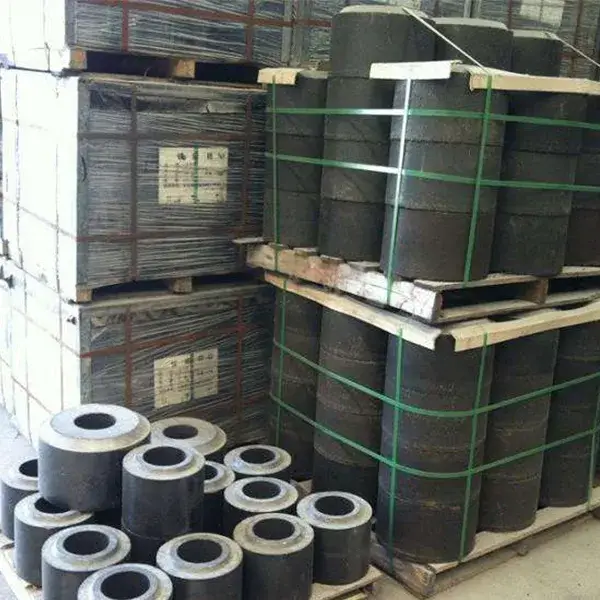
The refractory lining of the EBT tap hole consists of end bricks, inner tube bricks, and outer perimeter bricks. The space between the inner tube bricks and the outer perimeter bricks is filled with dry ramming mix to facilitate replacement while the tap hole is hot. The inner tube bricks are designed with a conical shape to allow the tap hole lining to open quickly.
The end bricks of the taphole are resin-bonded magnesia-carbon bricks, magnesia-chromium bricks, zirconia bricks, or similar materials. Common magnesia-carbon bricks use high-purity sintered magnesia and flake graphite as the main raw materials, with the addition of antioxidants. The inner tube bricks are also resin-bonded magnesia-carbon bricks, made primarily from fused magnesia and flake graphite, with the addition of antioxidants. The outer bricks are asphalt-impregnated magnesia bricks, manufactured primarily from high-quality sintered magnesia.
EBT refractory material should possess the following properties:
(1) During smelting, it must function as part of the furnace bottom refractory lining to ensure safety throughout the smelting process.
(2) It should possess suitable sintering properties to form a uniform and relatively thin sintered layer, which prevents high-temperature molten steel from seeping into the lower part of the tapping hole while ensuring the filler does not float.
(3) The particle size of the EBT filler must be appropriate; particles must not be too large to prevent molten steel from penetrating into the interior of the filler during smelting, which could pose a hazard.
(4) During smelting, the EBT filler should be divided into three layers: the topmost layer is a high-viscosity liquid phase layer, followed by a sintered layer, and the bottommost layer is a loose layer.
Magnesium olivine sand, calcium-magnesium olivine, and similar materials are used as taphole fillers.