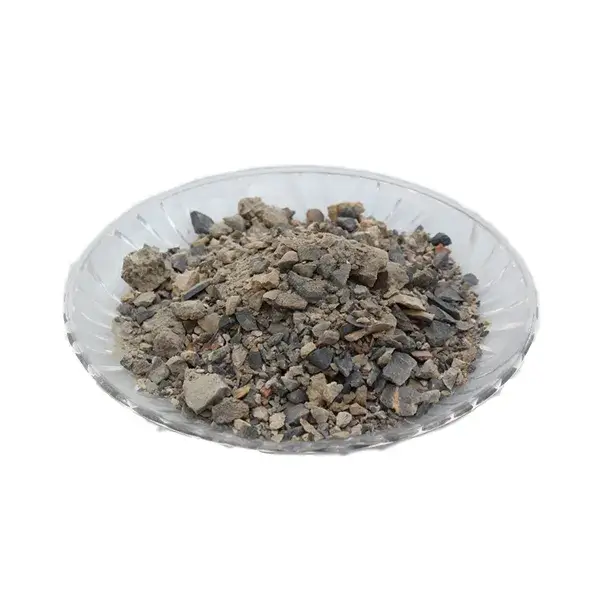
Once the various raw materials for a castable refractory have been determined, they must first be proportioned appropriately and then mixed to form a composite material; in some cases, this mixture may also require a period of “tempering” (resting/aging). Depending on the properties of the mixture, it is cast into shape using an suitable method and then cured. Finally, the hardened structure must undergo a proper drying or “firing-in” (baking) process before it is put into service.
1.Formulation of Pelleted Feed
The granular components of various size fractions should be proportioned based on the principle of achieving maximum packing density.
Since castables are frequently used to construct large-cross-section structures or to manufacture large-scale precast blocks, the maximum particle size of the aggregates can be increased accordingly. However, to prevent the bond between the coarse aggregates and the cement matrix from being compromised by excessive differential thermal expansion during heating, it is necessary to select aggregates with low thermal expansion and to carefully control the maximum particle size. Generally, the maximum particle size should be limited to 10–15 mm for vibration-molded products, and to less than 10 mm for machine-pressed products. For large-scale components or monolithic structures, it should not exceed 25 mm. In all cases, the maximum particle size should be less than one-fifth of the smallest cross-sectional dimension of the element.
Typically, the aggregates are composed of 3 to 4 distinct size fractions, with the total aggregate content accounting for 60%–70% of the mix.
Fine-grained admixtures—which are volumetrically stable at high temperatures and possess a very high degree of fineness (including a proportion of ultrafine particles)—contribute positively to both the ambient and high-temperature properties of castables. These should be incorporated in appropriate amounts; generally, a fine-powder content of 30%–40% is considered suitable.
2.Determination of Binders and Accelerators
The type of binder selected depends on the required properties of the structure or product, the material composition of the chosen granular and powdery components, and the specific construction conditions.
When manufacturing castables composed of non-alkaline granular materials, cement is typically used as the binder. When using cement, one must consider the requirements for both ambient and high-temperature properties of the hardened material. It is advisable to select a cement that offers rapid hardening and high strength, while containing a low level of low-melting-point impurities. The dosage should be appropriate—generally, it is recommended not to exceed 12%–15%. To prevent a decline in the strength of the hardened material at intermediate temperatures and to enhance its high-temperature resistance, the amount of cement should be minimized and partially replaced with ultra-fine powder additives.
If phosphoric acid or phosphates are used as binders, the concentration of the diluted phosphoric acid or phosphate solution should be determined based on the required properties of the hardened castable and the specific construction requirements. A phosphoric acid concentration of approximately 50% is generally suitable, with an addition rate typically controlled between 11% and 14%. When aluminum phosphate is used as a binder—with an Al₂O₃/P₂O₅ molar ratio of 1:3.2 and a relative density of 1.4—the addition rate should be kept at approximately 13%. Castables formulated with this type of binder exhibit slow setting and hardening, as well as very low strength, prior to heat treatment; therefore, a small amount of an alkaline material is often added to accelerate the setting process. If standard high-alumina cement is used as an accelerator, the typical addition rate is 2%–3%.
When using water glass (sodium silicate), its modulus and density must be controlled. With a modulus of 2.4–3.0 and a relative density of 1.36–1.40 g/cm³, the typical dosage is 13%–15%. If sodium fluorosilicate is used as a hardening accelerator, its dosage is generally 10%–12% of the weight of the water glass.
The selection and dosage of other types of binders are determined by the characteristics of the non-plastic (granular/powdery) components, the desired properties of the hardened material, and the specific construction requirements.
3.Water consumption
All types of castables contain a certain amount of water, the quantity of which is determined by the proportion of the binder used. Water can be added after the binder and the aggregate (non-plastic components) have been mixed; this approach is commonly used for calcium aluminate cements, which are prone to rapid hydration and setting. Alternatively, water can be pre-mixed with the binder to form an aqueous solution or sol of a specific concentration before being added to the mix—a method typically employed for binders that require prior hydrolysis to develop adhesive properties. In cases where the binder does not degrade upon reacting with water, it is often pre-mixed with water to ensure a uniform distribution throughout the castable; examples of this include phosphoric acid and sodium silicate (water glass).
For castables composed of aluminosilicate aggregates bonded with standard high-alumina cement, the water-to-cement ratio generally ranges from 0.4 to 0.65. Specifically, for castables shaped via vibration, the ratio is typically 0.5–0.65, corresponding to a water content of 8%–10% in the mixture; for those shaped by mechanical pressing, the ratio is usually around 0.4, with a water content of 5.5%–6.5%. To reduce the water content in the castable and increase the density of the hardened material, appropriate plasticizers and water-reducing agents should be incorporated.
4.Conserve
Once cast, castables must be cured using appropriate methods tailored to the hardening characteristics of their specific binders. For castables bonded with calcium aluminate cement, curing requires controlled temperature and moisture conditions. Specifically, standard high-alumina cement-bonded castables should initially be covered and kept at a relatively low temperature (below 35°C); once set, they should be cured by watering or immersion for 3 days. Low-calcium, high-alumina cement-bonded castables require 7 days of curing or 24 hours of steam curing. Castables bonded with certain inorganic metal salts—such as sodium silicate (water glass)—must undergo a drying and baking process. These should be kept in air at 15–25°C for 3–5 days, protected from moisture, and may subsequently be baked at temperatures below 300°C. Under no circumstances should they be cured in damp conditions or exposed to water; doing so causes the silica gel to absorb water and swell, leading to a loss of binding properties and a sharp decline in strength. For phosphate-bonded castables, the material should first be cured in air at 20°C or higher for at least 3 days, followed by baking at 350–450°C. Prior to baking, these materials must also be kept free from moisture and water exposure.
When castables are used to form the linings or furnace bodies of thermal equipment, they generally require a “curing” or “drying-out” process (baking) before their initial use. This process facilitates the gradual removal of physical and chemically bound (crystalline) water, stabilizes the material’s volume and specific properties, and achieves a certain degree of sintering. The appropriateness of the baking schedule has a significant impact on the service life of the lining. The fundamental principle for establishing a baking schedule is to ensure that the heating rate is compatible with the dehydration processes and other phase transformations or structural changes that may occur. During temperature ranges where such changes are rapid, the heating rate should be slowed down, or the temperature should be held constant for an extended period. If the baking process is improper—or omitted entirely—and the material is subjected to rapid heating before being put into service, it is highly susceptible to severe cracking, structural loosening, or even collapse; in the case of exceptionally large or thick sections, there is also a risk of explosion. The appropriate baking rate for a hardened castable depends on the type of binder used and the cross-sectional dimensions of the structure. For cement-bonded castables, the process can generally be divided into three stages:
(1) Removal of free water: Heat at a rate of 10–20°C/h to a temperature of 110–150°C, and maintain this temperature for 24–48 hours.
(2) Removal of chemically bound (crystalline) water: Heat at a rate of 15–30°C/h to 350°C, and maintain this temperature for 24–48 hours.
(3) Soaking (uniform heating) stage: Heat at a rate of 15–20°C/h to 600°C, and maintain this temperature for 16–32 hours; subsequently, heat at a rate of 20–40°C/h until the final operating temperature is reached. For structures with larger cross-sections, the lower end of the heating rate range and the upper end of the holding time range should be applied; the opposite applies to structures with smaller cross-sections.