In recent years, the rapid development of ladle refining and continuous casting technologies has transformed the ladle into both a vessel for holding molten steel and a refining unit. This has significantly extended the residence time of molten steel within the ladle and led to higher tapping temperatures and more rigorous smelting conditions, resulting in a substantial reduction in the service life of ladle linings. The use of monolithic casting with Al-Mg castables (including spinel-containing varieties) has become a prevailing trend.
Five main types of binders are commonly used in Al-Mg castables:
Water-glass bonding system
Water glass consists of alkali metal silicates and exhibits excellent bonding strength. Based on the type of alkali metal oxide, it is classified into sodium water glass (Na₂O·nSiO₂), potassium water glass (K₂O·nSiO₂), and potassium-sodium water glass (K₂O·Na₂O·nSiO₂). It primarily develops bonding strength through natural air-drying and heat-induced dehydration, processes that lead to gel formation.
Phosphoric acid and aluminum phosphate composite system
Industrial-grade phosphoric acid has the molecular formula H3PO4·0.5H2O; it appears as prismatic crystals and is soluble in water in any proportion. There are three types of phosphoric acid, the most stable being orthophosphoric acid, commonly referred to simply as phosphoric acid (H3PO4). Its bonding mechanism involves reacting with oxides in the material to form compounds, thereby generating bonding strength.
Aluminum phosphate is also used as a binder for refractory materials; it is typically produced by the reaction of phosphoric acid with aluminum hydroxide and exists in forms such as aluminum monohydrogen phosphate and aluminum dihydrogen phosphate.
Spinel-high-alumina castables prepared using calcined high-alumina bauxite and fused spinel fines as the primary raw materials, with phosphoric acid as the binder, exhibit excellent thermal shock resistance and slag resistance. The phosphoric acid reacts with free MgO in the spinel to form magnesium dihydrogen phosphate, which subsequently polymerizes into magnesium phosphate, thereby generating strength. This bonding method also extends the working time and improves the castable’s resistance to hydration.
MgO+2H3PO4=Mg(H3PO4)2+H2O (1)
nMg(H2PO4)→nMg·2nPO3+2nH2O (2)
MgO·SiO2-H2O bonding system
This bonding system relies on the agglomeration of fine powders and is commonly found in bauxite-based castables. The introduction of CaO must be avoided in this system, as it leads to the formation of low-melting-point phases at high temperatures—significantly impairing the material’s high-temperature performance. Fine SiO2 micropowder can react with water as follows:
SiO2+H2O=Si-OH++OH- (3)
The advantages of this system include high strength following intermediate-temperature treatment: M-S-H contains relatively little water of crystallization, facilitating rapid drying; at high temperatures, the reaction between SiO₂ and MgO forms forsterite, enhancing high-temperature performance; and SiO₂ improves the flowability of the castable. Its disadvantage is relatively poor resistance to slag erosion.
Hydrated alumina bonding
Among the various crystalline forms of Al2O3, only ρ-Al2O3 undergoes spontaneous hydration at room temperature; its bonding mechanism in castables involves hydration to form hydrargillite and boehmite sols, as shown in the following reactions:
ρ-Al2O3+2H2O=AI(OH)3+AlOOH (4)
ρ-Al₂O₃ is an amorphous substance; the disordered arrangement of Al—O bonds and the lack of valence within it confer high reactivity, resulting in a rapid hydration reaction. At room temperature, the self-catalytic reaction causes the hydration rate of ρ-Al₂O₃ to increase with rising temperature. However, the hydration reaction of ρ-Al₂O₃ is quite vigorous and difficult to control, leading to poor material stability.
A study comparing the performance differences between alumina-magnesia castables bonded with hydrated alumina and those bonded with cement showed that alumina-magnesia castables containing 3 wt% hydrated alumina exhibited better slag resistance, permeability resistance, and thermal shock resistance than cement-bonded castables.
The characteristics of alumino-magnesian castables bonded with different binding systems were investigated. The study showed that at high temperatures, the dehydration of hydrated alumina causes slight shrinkage around the formed ρ-Al₂O₃. The annular region formed by this shrinkage acts to inhibit crack propagation and relieve stress, thereby improving the material’s thermal shock resistance.
Aluminate cement bonding system
Currently, the aluminum-magnesium-based ladle permeable bricks and other castables most widely used in industrial applications are primarily bonded with calcium aluminate cement. Castables using aluminate cement as a binder form 2CaO·Al₂O₃·8H₂O and Al(OH)₃ colloids at room temperature, exhibiting high demolding strength; however, their strength is relatively low after medium-temperature treatment. When treated at temperatures above 1400°C, CA6 is formed, and the material’s strength increases significantly; however, use at excessively high temperatures can lead to structural spalling, thereby limiting their application.
Research on low-cement refractory castables (LCC) and ultra-low-cement refractory castables (ULCC) has reduced the amount of cement used. In traditional refractory castables, the cement content ranges from 10% to 15%, whereas in ULCC, the cement content is only 2 wt% to 3 wt%.
Mechanism of strength change in aluminate cement refractory castables: the relationship between their relative compressive strength (with compressive strength after drying at 110°C set as 100%) and heating temperature. As shown in Figure 1, it can be seen that after the initial setting of the aluminate cement castable, standard curing yields high strength at room temperature; however, the strength decreases after drying, which is attributed to the dehydration of the hydration products 2CaO·Al₂O₃·8H₂O and Al(OH)₃.
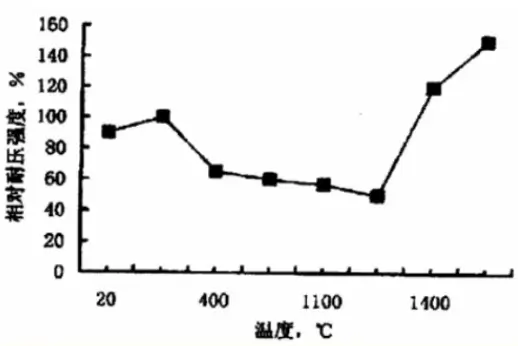
The high-temperature compressive strength characteristics of alumina-based cement-bonded refractory castables are as follows: when heat-treated below 1000°C, their high-temperature compressive strength differs little from their cold compressive strength; as the temperature rises, a liquid phase appears, reducing the material’s high-temperature strength; when the temperature continues to rise to 1350°C, its high-temperature compressive strength is only 2 MPa.
When the material is heated to approximately 300°C, rapid crystalline transformation occurs and a large amount of free water is expelled; consequently, the relative strength decreases significantly, typically by 18–25%. Between 300 and 900°C, the free water and the vast majority of the bound water in the material are lost through calcination, resulting in a significant increase in apparent porosity. At temperatures between 900 and 1200°C, chemical reactions occur, producing CA and CA₂, which form new mineral structures and cause volumetric shrinkage. At the same time, due to the relatively low temperature and limited sintering, the internal structure of the material becomes porous, and its strength decreases significantly—to approximately half that of the material after drying. When observed under a microscope, specimens treated at 1200°C exhibit a microstructure composed of separate, roughly uniform-sized lumps; consequently, their strength is the lowest. After heating to 1300–1400°C, the strength recovers and increases substantially due to the formation of the stable product CA6 and the establishment of a ceramic bond (Figure 2).
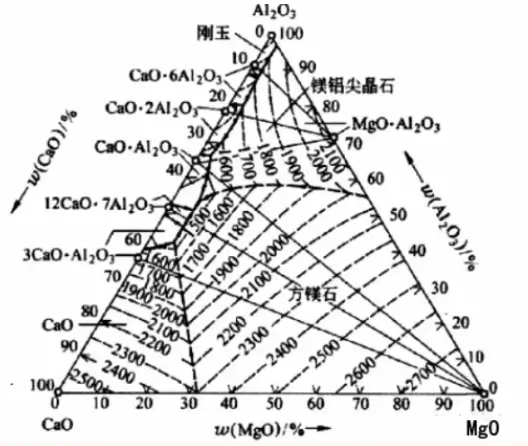
The research results indicate that at 1300°C, corundum and calcium dialkylate are the primary crystalline phases of the composite material, and the CA₂+m₂O₃ → CA₆ reaction begins; at 1400°C, CA₂ decreases significantly while CA₆ is formed in large quantities; as the temperature continues to rise to 1500°C, the reaction concludes, and the primary crystalline phases of the material are corundum and CA₆.
Due to the anisotropic growth of CA6 grains, which predominantly adopt a plate-like or needle-like structure, and because CA6 has a thermal expansion coefficient similar to that of alumina and exhibits strong compatibility with it, incorporating CA6 into alumina-based ceramics or coatings significantly improves the mechanical properties of these materials.
In calcium aluminate cement-bonded castables, CA6 is the product of chemical reactions occurring in the material’s matrix at high temperatures. Its plate-like crystal morphology can interlock with spinel grains to form a network-like structure, effectively enhancing the material’s strength.