The lining of a coreless induction furnace can suffer varying degrees of damage due to prolonged melting or improper operation. This damage can often be salvaged through early repairs, saving both cost and time.
Based on experience, we have summarized the following causes of lining damage in coreless induction furnaces and their corresponding repair methods:
Cracks and damage at the taphole
Causes of damage:
① Mechanical impact during the charging of metal materials;
② Adhesion of slag and residual iron.
Main repair methods:
① Remove slag and residual iron;
② Repair by tapping with unshaped refractory material;
③ For larger repair areas, dry with charcoal or similar materials.
Side cracks
Cause of damage:
Cracking occurs when the molten iron is completely tapped and the furnace temperature drops below 800℃.
The structure and shape of the taphole are prone to localized cracking.
Main repair methods:
① When cracks larger than 2mm appear, they must be repaired promptly. Remove slag and residual iron around the crack; use a refractory material for furnace repair with the same amount of boric acid added as when building the furnace, mix it evenly, sieve it through a 2mm diameter sieve, and fill the crack with tools such as iron wire; ② Smooth the filled surface with wet mixed sand containing water glass.
Sidewall damage or small-scale erosion
Causes of damage:
① Mechanical impact during the charging of metal materials; foreign matter introduced during the compaction of the furnace lining material; ② Introduction of heavy metals such as Zn and Pb.
Main repair methods:
① After removing slag and residual iron from the area to be repaired, apply water glass to its surface; ② Add 5-6% water glass to the furnace repair material, mix thoroughly, and then pat and repair, or use Al2O3 monolithic refractory material for repair.
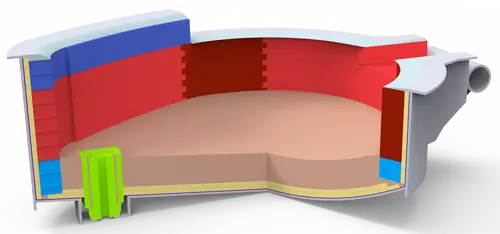
Burns or damage to the bottom and side walls (sloping sections)
Causes of damage: ① Burn-off due to molten iron flow; ② Excessive heating when there is little remaining molten iron.
Main repair methods:
① Remove slag and residual iron adhering to the bottom and sides;
② If a molten iron leakage alarm wire is installed at the bottom of the furnace, drill a 200mm diameter hole in the center of the bottom until the refractory brick is exposed, and replace the alarm wire;
③ Add boric acid and refractory material mixed evenly with the newly constructed furnace, and tamp it down with a forked tamping rod;
④ Remove the refractory material protruding from the bottom of the furnace to the specified size;
⑤ Fill the furnace with a layer of refractory material with an outer diameter 50-60mm smaller than the inner diameter of the electric furnace, tamp it down, roughen the top surface, and then tamp down another layer until it is 10mm higher than the crucible mold. Then, shape the top surface with a certain slope.
Mild or severe corrosion of the upper sidewall
Causes of damage: ① Mechanical impact during the addition of metal charge; ② Chemical reaction with slag to produce low-melting-point substances.
Main repair methods:
- For minor corrosion, after the furnace cools, remove the slag and residual iron, then use unshaped refractory material and tamp it with a wooden mallet for repair.
- For severe corrosion, crucible mold repair can be used: remove the furnace lining from the damaged area to the top; insert a crucible mold, sealing the gap between the crucible mold and the upper sidewall with wet refractory mud; add 60-70mm of high-quality refractory material each time, then tamp it down with a forked tamping rod.
- Hot repair: remove half of the molten iron in the furnace, add metal charge equal to 10% of the furnace capacity, and melt using the lowest power setting; insert the crucible mold, add unshaped refractory material, and tamp it down with a tamping rod.
Before each charging, the furnace diameter and the extent of furnace lining damage should be checked. During the smelting process, the data displayed on the electrical control cabinet should be monitored, such as the input voltage, power factor, current value, and capacitance value under rated power conditions, to accurately determine the degree of furnace lining damage.
In addition to the above furnace lining repair methods, the following points must be noted: For minor repairs (refractory mud repair), used for repairing cracks and upper sidewalls, smelting should be carried out using conventional smelting processes. When the molten iron rises to 10cm from the repair area, hold it at that temperature for 30-60 minutes before continuing smelting. When repairing with a crucible mold, before the temperature of the molten iron at the bottom and sidewall reaches 1200-1250℃, heat and melt at 1.5 times the normal rate for rebuilding the furnace. Once the molten iron level rises to the repair area, smelt using 60-70% of the rated power. When the temperature reaches 1600℃, hold it at that temperature for half an hour to an hour.
The lifespan of electric furnace linings is also closely related to the refractory materials used. Currently, quartz lining materials are primarily used in cast iron smelting, especially in furnaces operating continuously (with crucible temperatures maintained at 800-1000℃). Using quartz acidic lining materials, the lifespan can reach over 100 heats. Commonly used basic lining materials are magnesia, magnesia-alumina, and magnesia-chromium dry-bridging materials. These materials effectively address the problem of low refractoriness in lining materials. Magnesia linings are characterized by their resistance to cracking, lower rates of steel leakage and seepage, thinner sintered layer, ease of dismantling, and absence of moisture.